


The Show Pony and the Sphinxes

The Horses of the Rider Waite Smith Tarot — Part 3
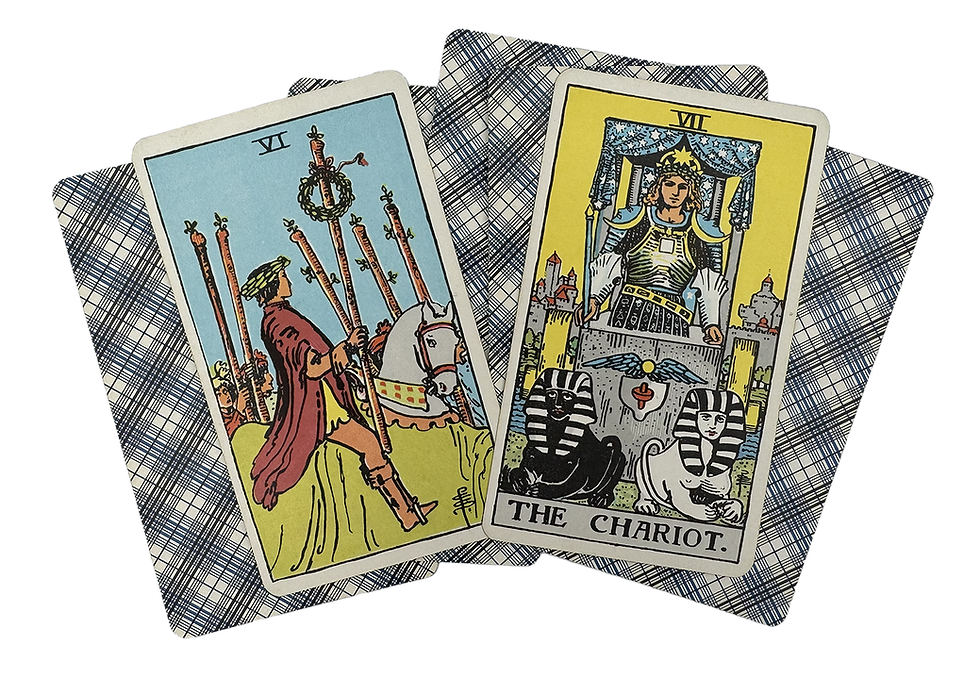
In the previous articles in this series, we explored the white horses of the Major Arcana and the distinctive mounts of the Knights. This final instalment turns to the ceremonial horse of the Six of Wands and the “horse-adjacent” sphinxes of The Chariot. Though very different in presentation, both cards invite us to consider how movement, control and public identity shape the journey of the tarot.
In my 1972 Rider deck, the horse of the Six of Wands is light grey. It is often written about as white, but there is an important distinction. Fun fact: true white horses are rare. Most are born darker and progressively lighten with age. Thus, a horse with a white coat is often a mature grey. While Death’s horse is a true white, even when the horse of the Six of Wands is depicted as white, it would most likely still be referred to as a grey. Rather than signifying purity or clarity, its coat instead suggests balance, impartiality or the middle ground. Not that we see much of it.

Draped in an ornate caparison, green like the rider’s laurel crown, the horse is largely obscured, blending into the procession itself. Its posture is controlled and balanced, while its backward glance directs our attention toward the rider and suggests attentive obedience. The young grey has no mane, marking it as a show horse while also likening it to a carousel pony. It is not presented as a force of instinct or temperament, but as an almost passive fixture of the procession, trained for spectacle and public display. Here, the horse serves less as an independent teacher and more as an extension of victory, recognition and social triumph.
Di Day, President of the Tarot Guild of Australia, did not include the Six of Wands in her recent article on animism and the horses of tarot, writing that “its message leans more heavily on public victory and the human figure’s recognition than on the horse as the primary teacher.” While I mostly agree that this mount is lacking in agency, even a show pony serves a purpose — and carries a message of its own.
And that brings us to the final card in this series: The Chariot. This “horse-adjacent” card brings us full circle, returning to the Hindu allegory mentioned in part one, in which the chariot is the body, the horses are the senses, the mind is the reins, and the charioteer is the intellect. The horses have been replaced by sphinxes, yet the analogy still holds. As mythical creatures, sphinxes are able to journey where horses may not. However, they are depicted in a state of stillness, unmoving.

Waite writes of the charioteer that he is “above all things, triumph in the mind.” Having mastered himself, he must now move beyond logical understanding and journey into the greater mysteries beyond himself. The grey of the chariot may also be viewed as a midpoint between the black and white sphinxes — a desire for balance between opposing forces. While the Knightly horses embodied instinct, temperament, will and movement, The Chariot asks a different question altogether: not simply how we travel, but what deeper force guides us beyond self-interest or personal victory toward meaning.
I hope you’ve enjoyed our ride with the Horses of the Tarot. This series is dedicated to ‘Hampton Star’ and written in gratitude to all the mounts and forces who have carried us. Let us know if there is any Tarot symbolism you’d like explored in a future series.
Discover our series on the Horses in the Tarot:
Part 2: Riding with the Knights
Leela J. Williams is an award-winning psychic creator. Discover her oracle decks and journals, including Zoologica: The Steampunk Oracle HERE.


Comments